
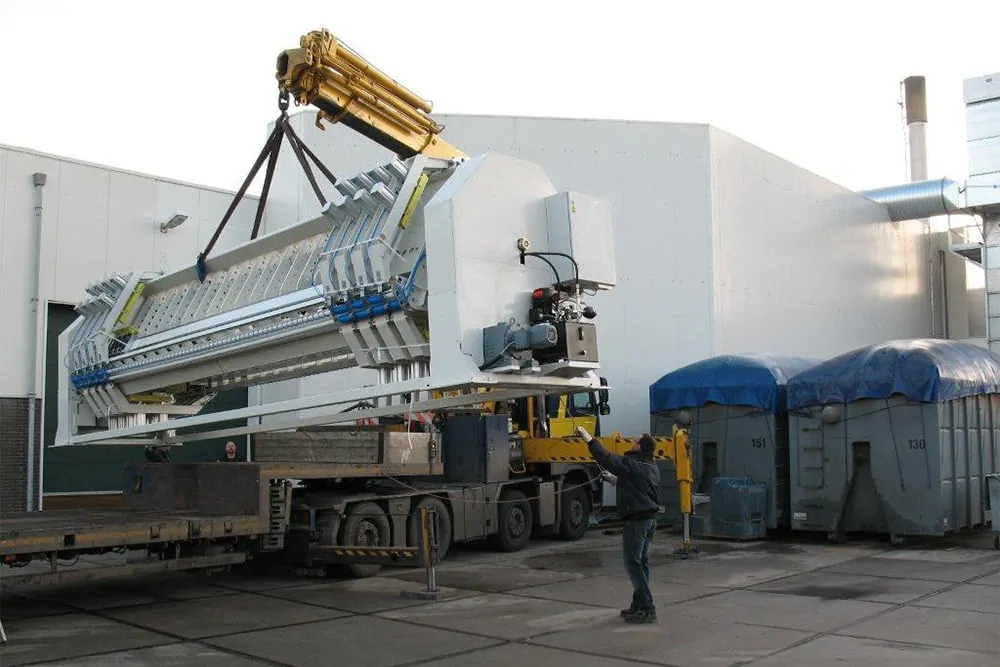
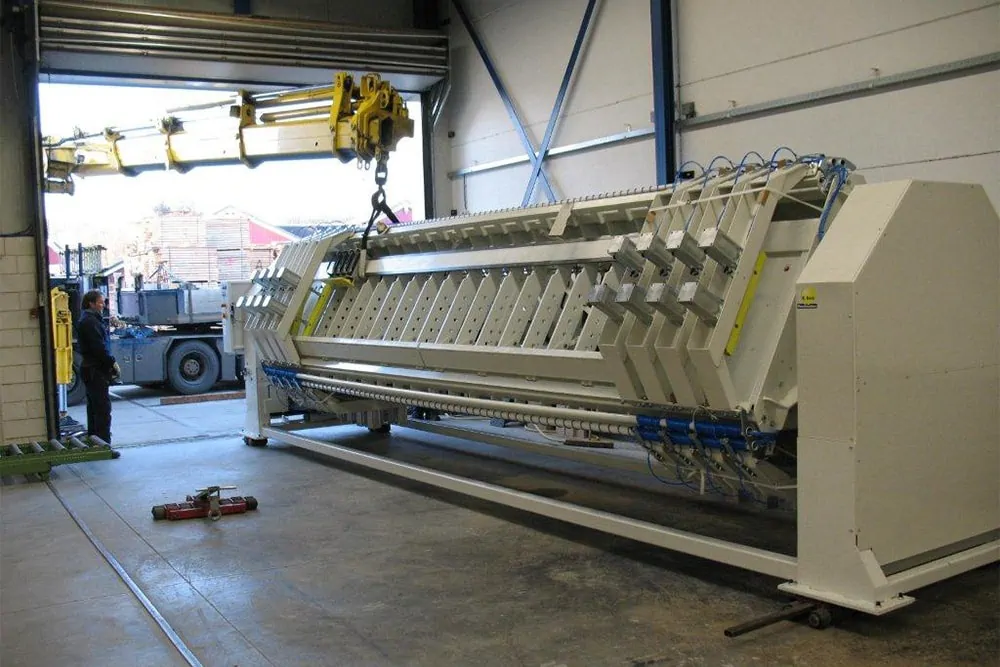
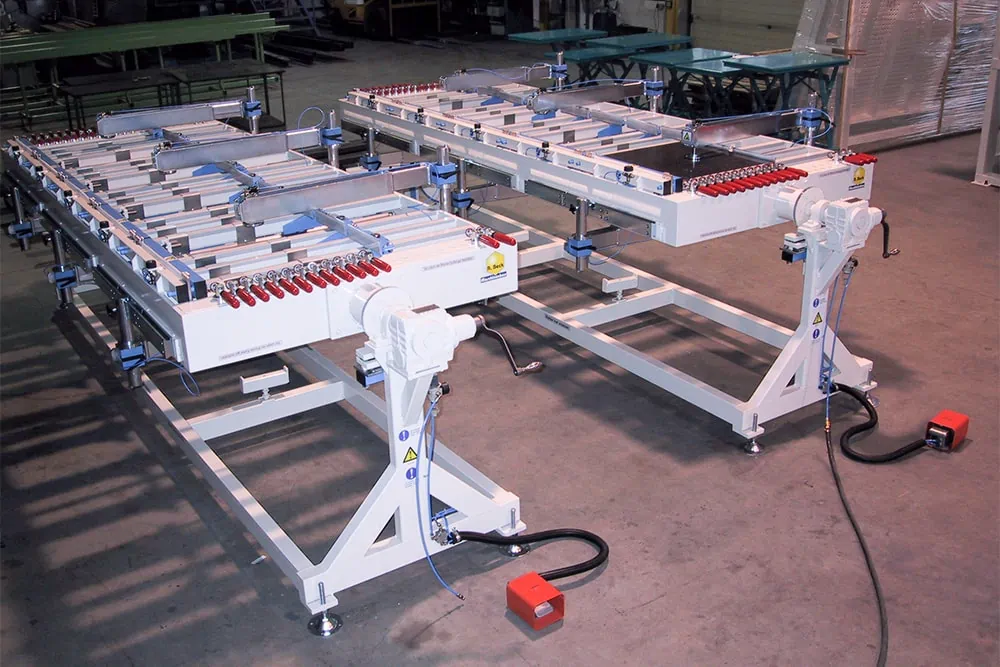
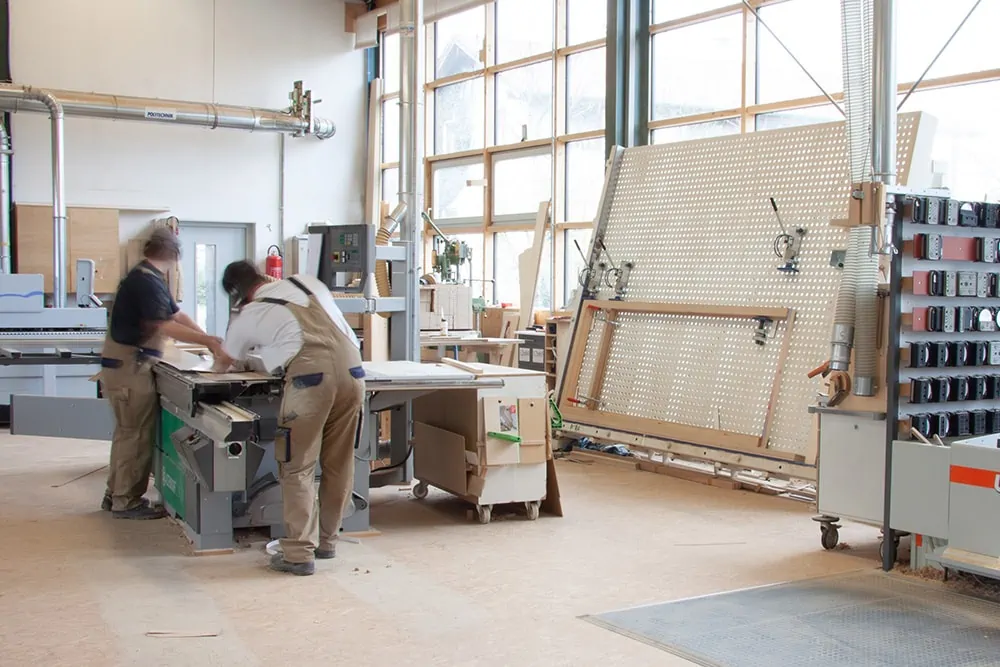
Gluing presses – often also referred to as frame presses or glue presses – are indispensable machines when it comes to joining wooden workpieces firmly and precisely using glue and pressure. Whether for manufacturing door and window frames, gluing solid wood panels, or gluing edges: a suitable gluing press ensures even pressure on the glue joint and thus stable, high-quality connections. Compared to the laborious work with screw clamps and makeshift clamping devices, gluing presses enable faster workflows and more precise results – a benefit for both craft businesses and industry alike.
Frame presses, perforated plate presses, multi-level presses, or gluing stands: there is a wide range of gluing press types available. Below, you can find out about the different variants, what they are used for, and what advantages they offer. We also provide tips on what to look out for when buying a gluing press and answer frequently asked questions about frame and glue presses.
Buy a gluing press - Applications
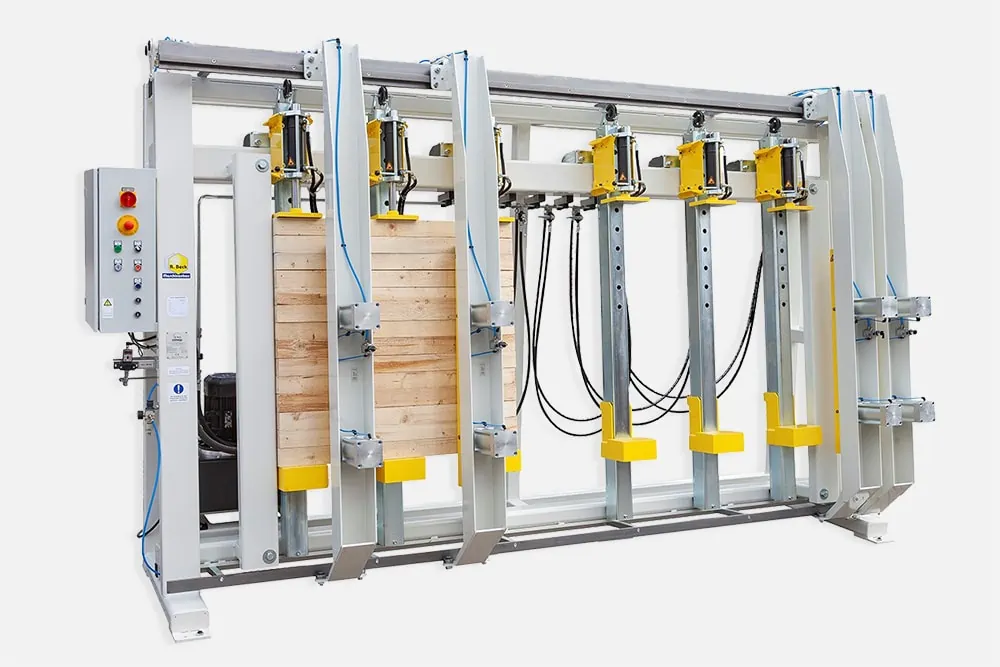
A gluing press is used to join wooden slats, frame timbers, or similar workpieces into solid components using glue and even pressure. Typical applications include gluing solid wood panels (by joining several boards together), manufacturing frames for doors and windows, and gluing edges to furniture parts. The machine usually consists of a sturdy steel frame as the base frame, fixed stops (abutments), and movable pressing elements that press down on the workpiece. The pressing force holds the glued parts in the desired position until the glue sets, creating a dimensionally stable connection.
The term “frame press” describes a special subgroup of gluing presses. Frame presses are primarily designed to accommodate right-angled workpieces such as window or door frames. They usually have fixed stop angles of 90° and adjustable pressure beams to clamp frame constructions quickly and precisely. In addition, there are also flexible perforated plate gluing presses with perforated clamping walls and multi-level presses with several press levels arranged one above the other – we will discuss these differences in more detail shortly.
How does a gluing press work? Essentially, a gluing press replaces numerous screw clamps and greatly simplifies the gluing process. Instead of laboriously clamping large workpieces to trestles with clamps, a gluing press allows you to work vertically at a comfortable height. The workpiece is aligned with stops and pressed against these stops by pressure elements (such as hydraulic clamping cylinders or spindle clamps). Modern presses have hole patterns (typically 50 mm or 70 mm spacing) for free positioning of the pressure elements, which allows for a high degree of flexibility when clamping. Depending on the machine type, the necessary pressing pressure is generated by a rack and pinion gear, manual hydraulics, or pneumatic or electrohydraulic cylinders, so that uniform pressure is applied over the entire length of the glue joint. The result is distortion-free, impact-resistant glued joints that are significantly more precise and resilient than joints glued by hand.
Advantages of our gluing presses at a glance
Instead of laboriously gluing large wooden components with screw clamps, the vertical design of modern gluing presses enables ergonomic working at an optimal height. Pressure distributed evenly across the entire joint leads to better results than selective screw clamp pressure—the precision and quality of the workpieces increases, while the health of employees is protected.
✅Ergonomic working:
Most gluing presses are designed so that you can work in an upright position at a comfortable working height. This protects your back and joints. Employees no longer have to bend over to tighten clamps, but can operate levers or hydraulics in a comfortable position. Presses are often mobile or can be set up flexibly so that they can be positioned optimally depending on the work process.
✅Uniform pressing pressure:
Thanks to its stable frame and distributed pressure points, a gluing press ensures even contact pressure across the entire glue joint. The result is gap-free joints without warping. Compared to applying pressure at specific points with individual clamps, the even pressure across the entire surface leads to a more precise fit and more stable, durable gluing.
✅Higher productivity:
Gluing presses save time and effort. Multiple clamping points can be tightened simultaneously with one device, eliminating the need to apply dozens of individual clamps. In addition, some machines (e.g., multi-stage presses) can glue several workpieces in parallel. This significantly reduces throughput times in production. Simple and quick handling (e.g., via foot pedal for hydraulic presses) ensures efficient workflows without long setup times.
✅Flexibility and versatility:
Thanks to modular systems, gluing presses can be adapted to different tasks. Adjustable stops and interchangeable accessories mean that a single press can be used for a variety of gluing tasks – from frames and panels to miter joints. Perforated plate presses offer a grid-based modular system in which press elements and hold-down devices can be positioned exactly where they are needed. This means that even unusual workpiece shapes such as arches or sloping structures can be clamped reliably.
✅High pressing forces for solid wood:
High, even pressure is crucial for achieving distortion-free results, especially when gluing solid wood (e.g., glued wood panels made of oak or beech). Hydraulic gluing systems often achieve pressing pressures of over 1,000 kg per clamping point. With special clamping hydraulics and hold-down devices, even thick hardwood boards can be glued flush in a very short time. This results in solid wood table tops or stair treads without visible joints or protruding teeth.
✅Quality and precision:
The robust steel construction of modern gluing presses ensures high repeat accuracy. Once adjusted, the angle remains exactly the same – important for frame gluing, for example, so that everything is at right angles later on. Professional machines “Made in Germany” rely on precise manufacturing: holes for hole patterns are cut by laser, for example, and powder-coated base frames ensure durability. The result is perfect angles and flush surfaces with every gluing job.
Bora
Quattra

Quattra 2
Quattra 3A+3B

Quattra Classic
Hydro-Export
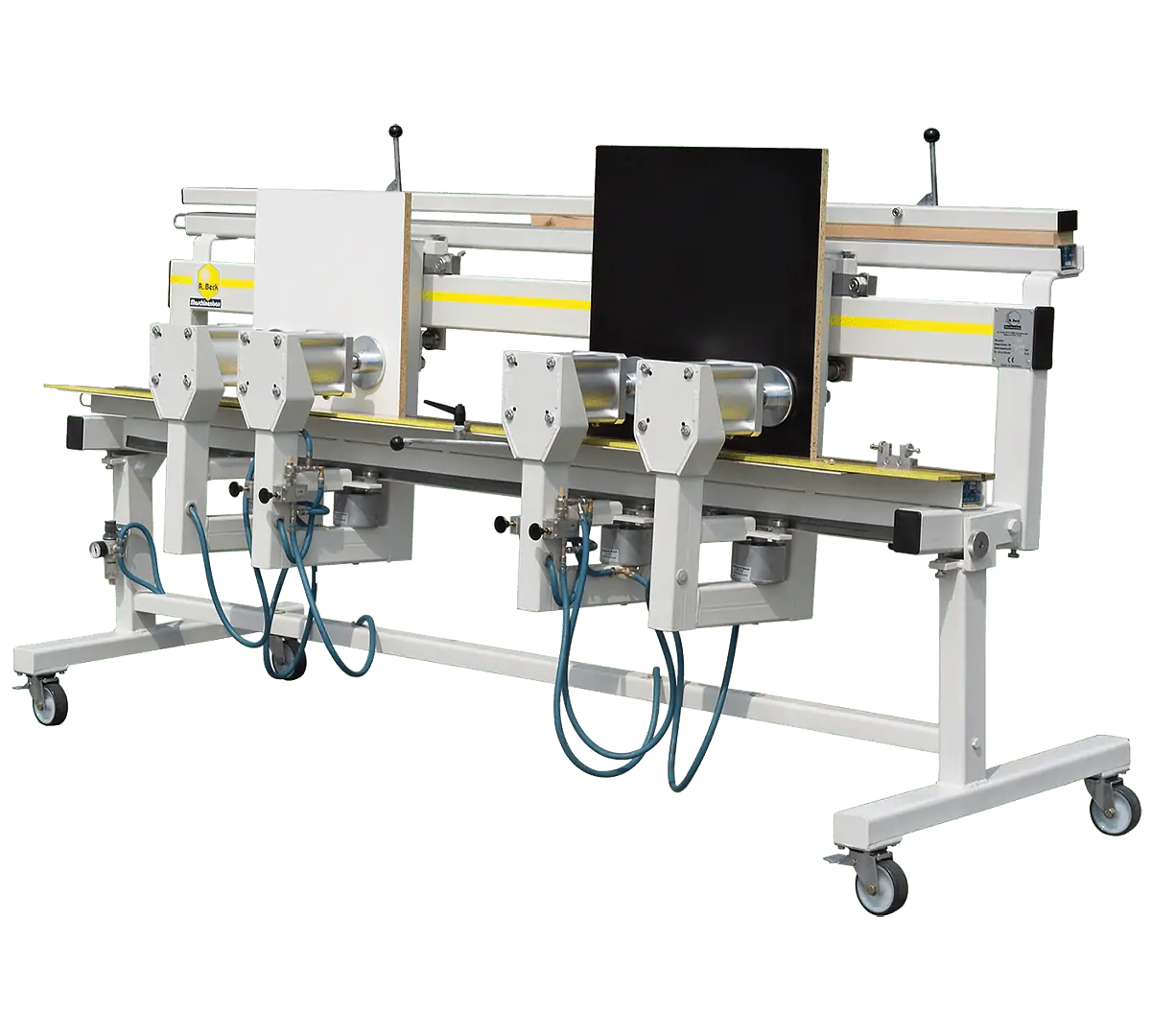
Mobil
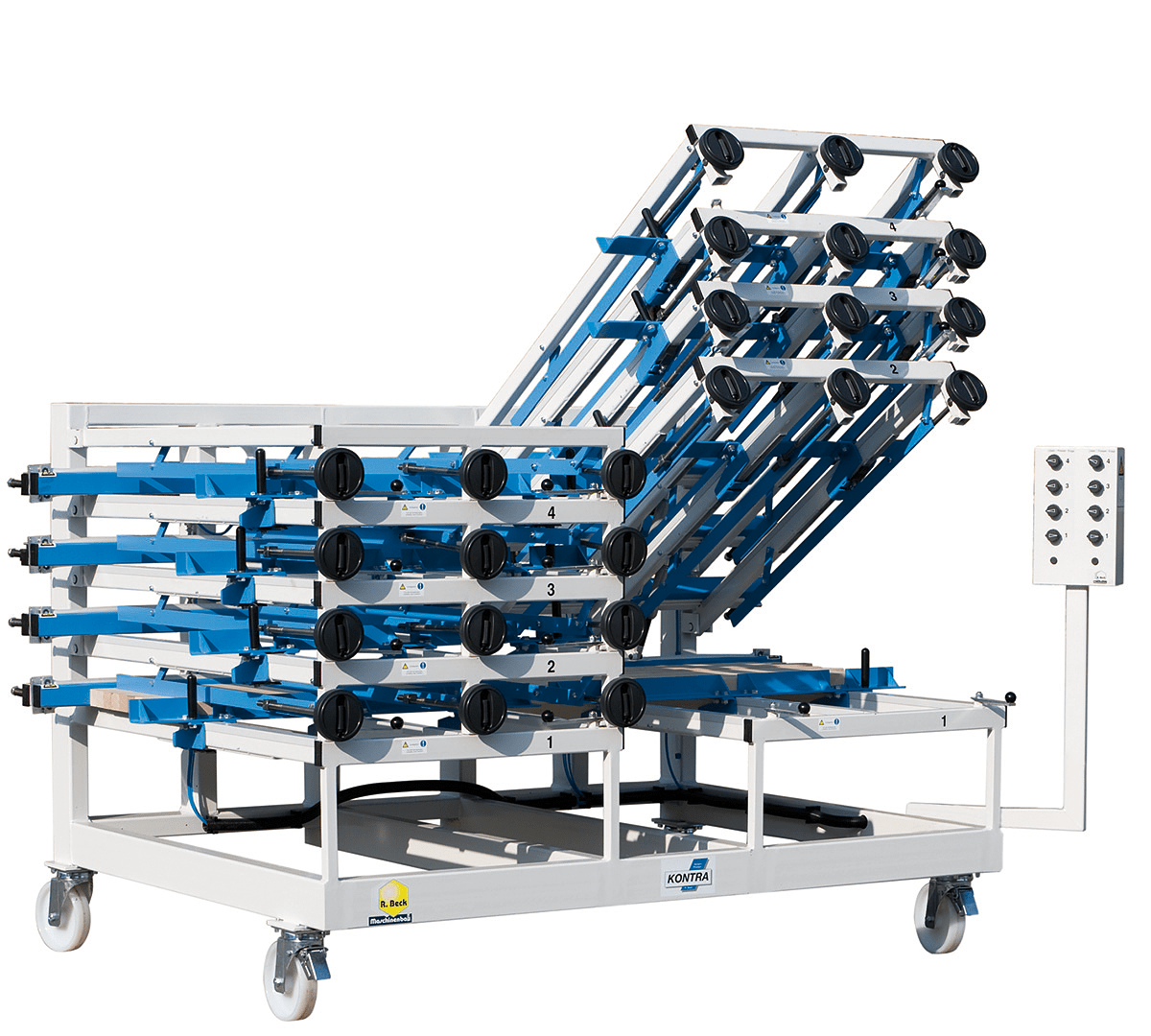
Kontra
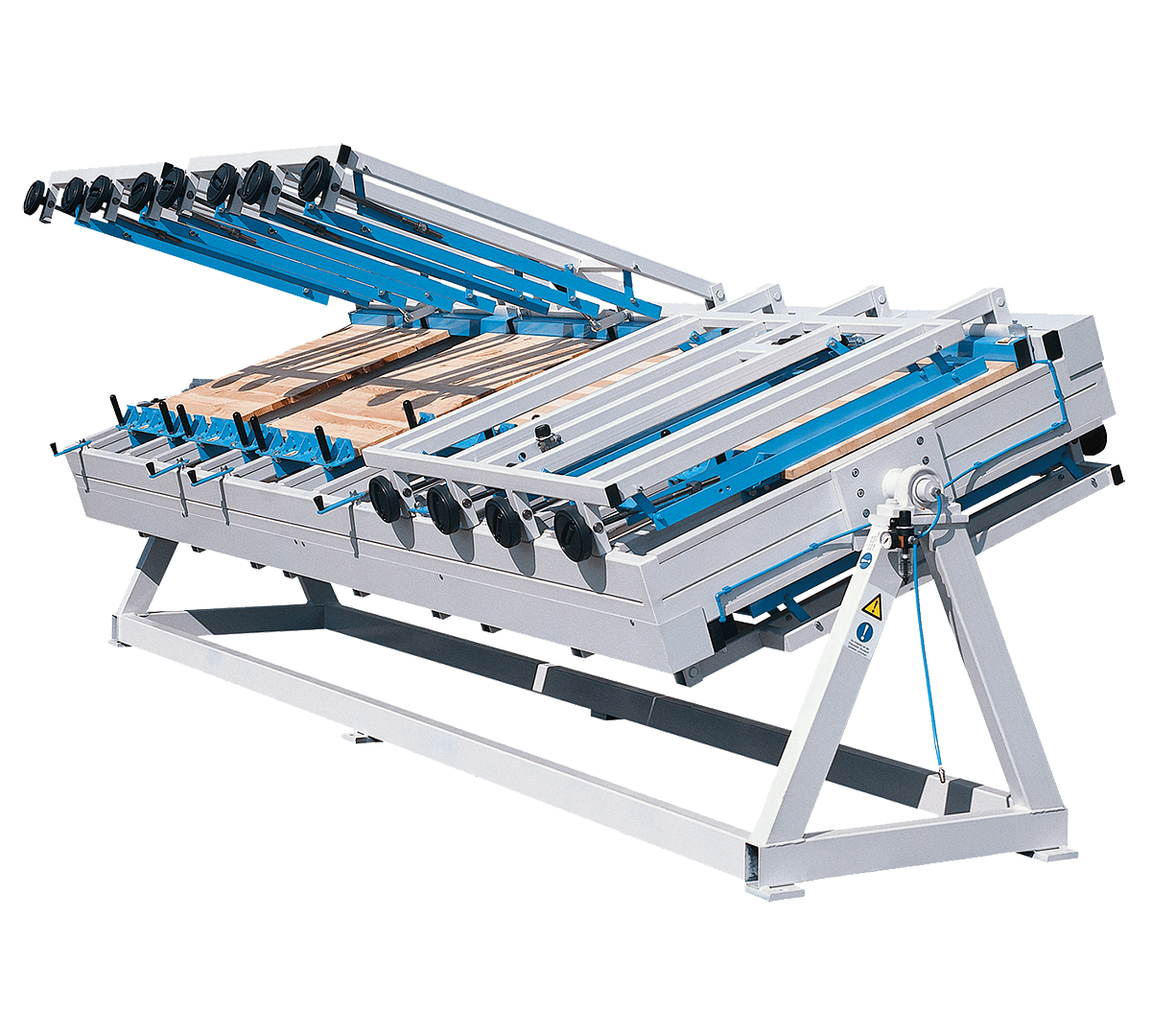
Kontra Comet
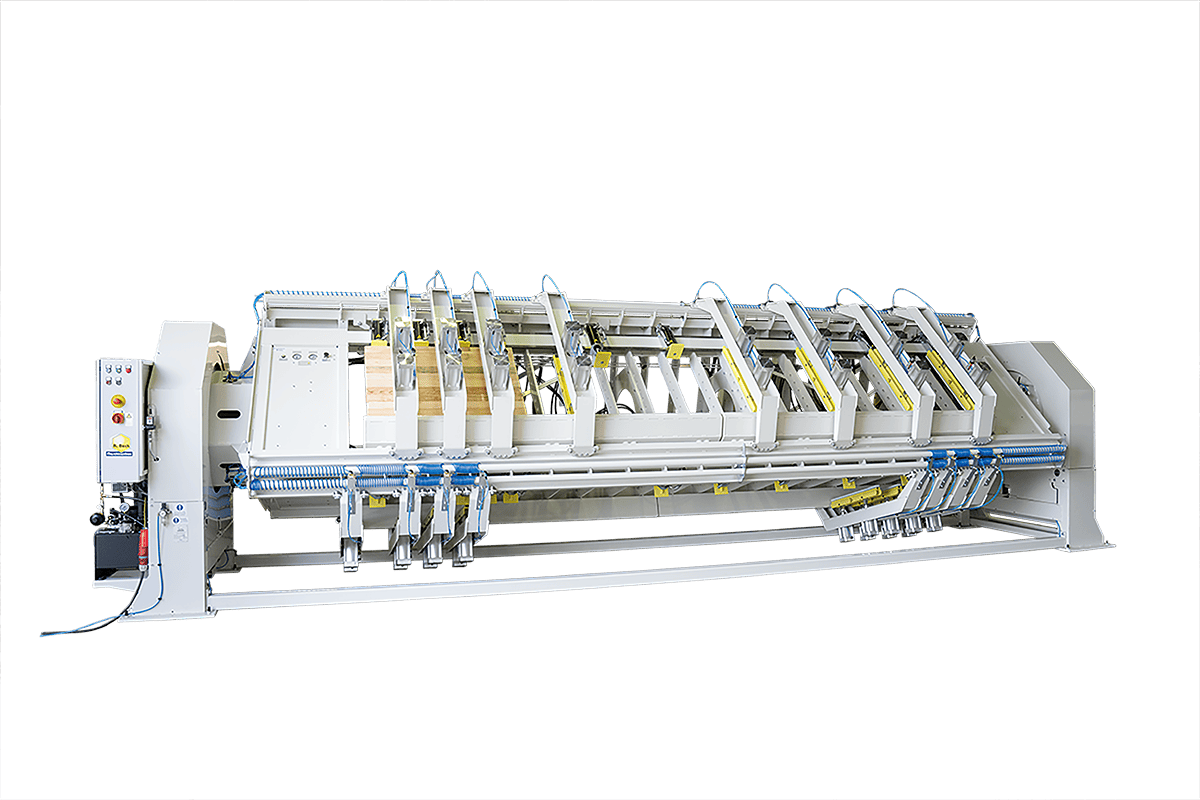
3-level gluing rotor
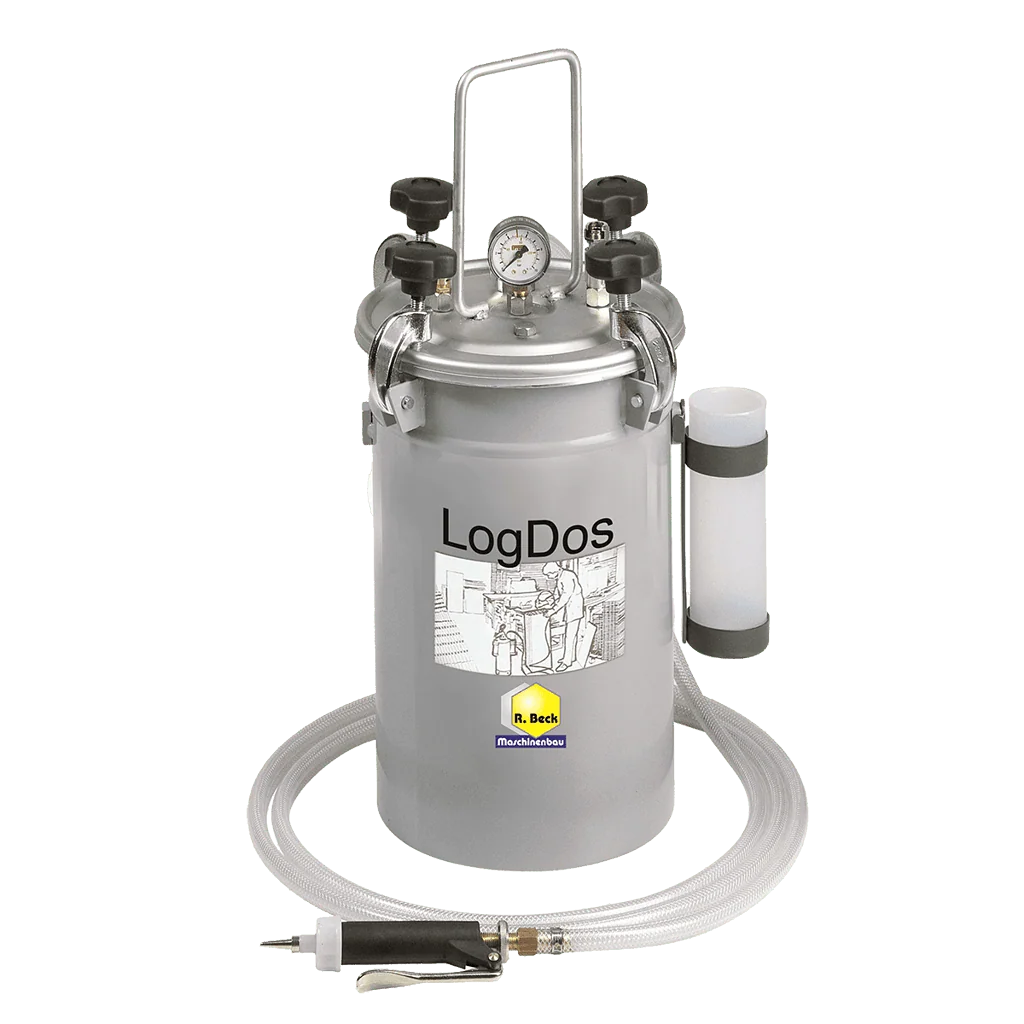
LogDos
Types of gluing presses and their areas of application
Various types of gluing presses have become established in wood technology, each of which is particularly well suited to specific applications. Here is an overview:
Frame presses
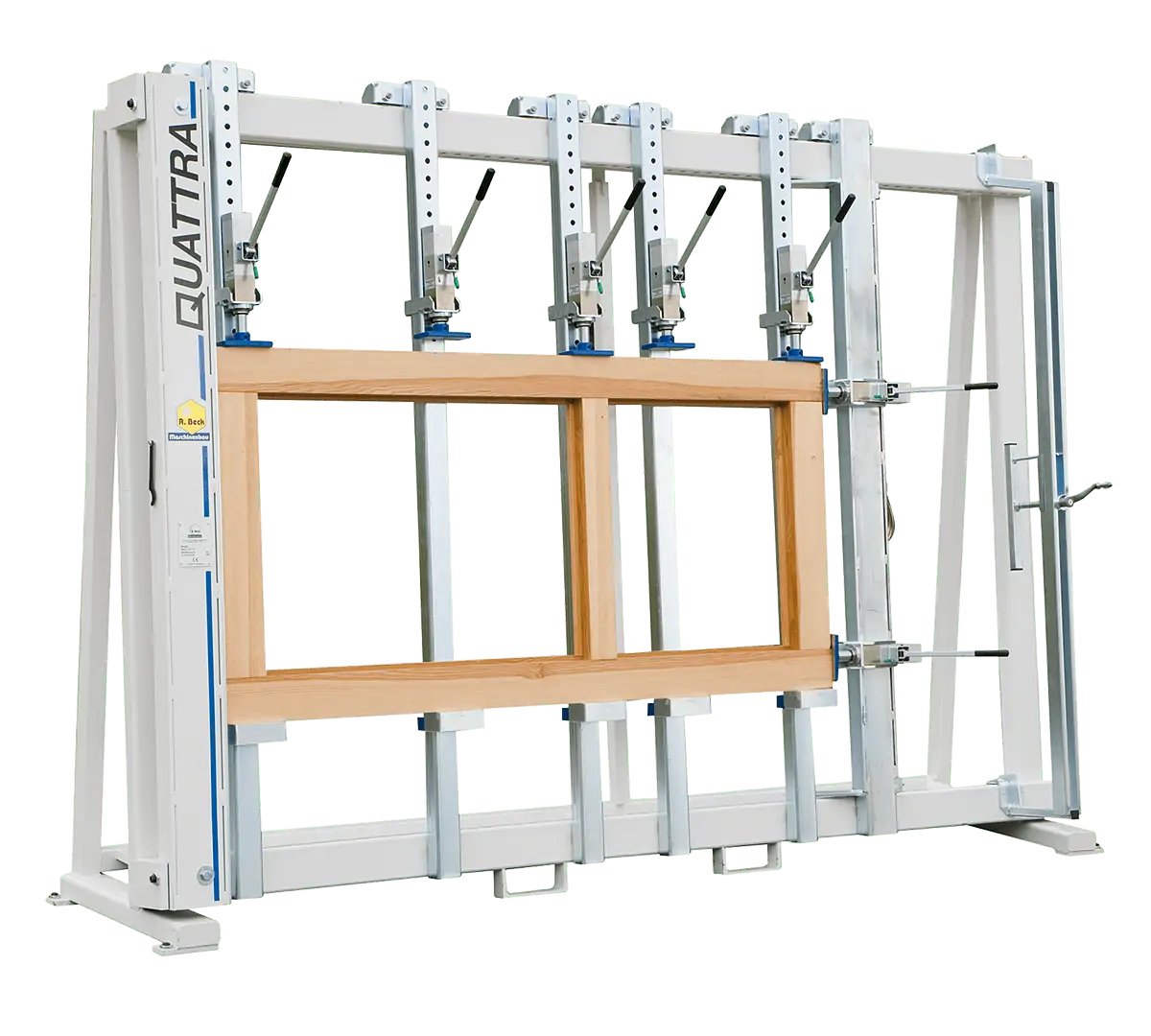
As the name suggests, frame presses are specially designed for gluing frame constructions. Typical workpieces include window frames, door leaves, picture frames, and similar rectangular constructions. A classic frame press has a rigid base frame with a fixed angle stop (usually 90°) and several adjustable pressure elements that act on the clamped frame from two sides (from above/below and from the side). This ensures that all corners of the frame are pressed together evenly and held at exactly right angles.
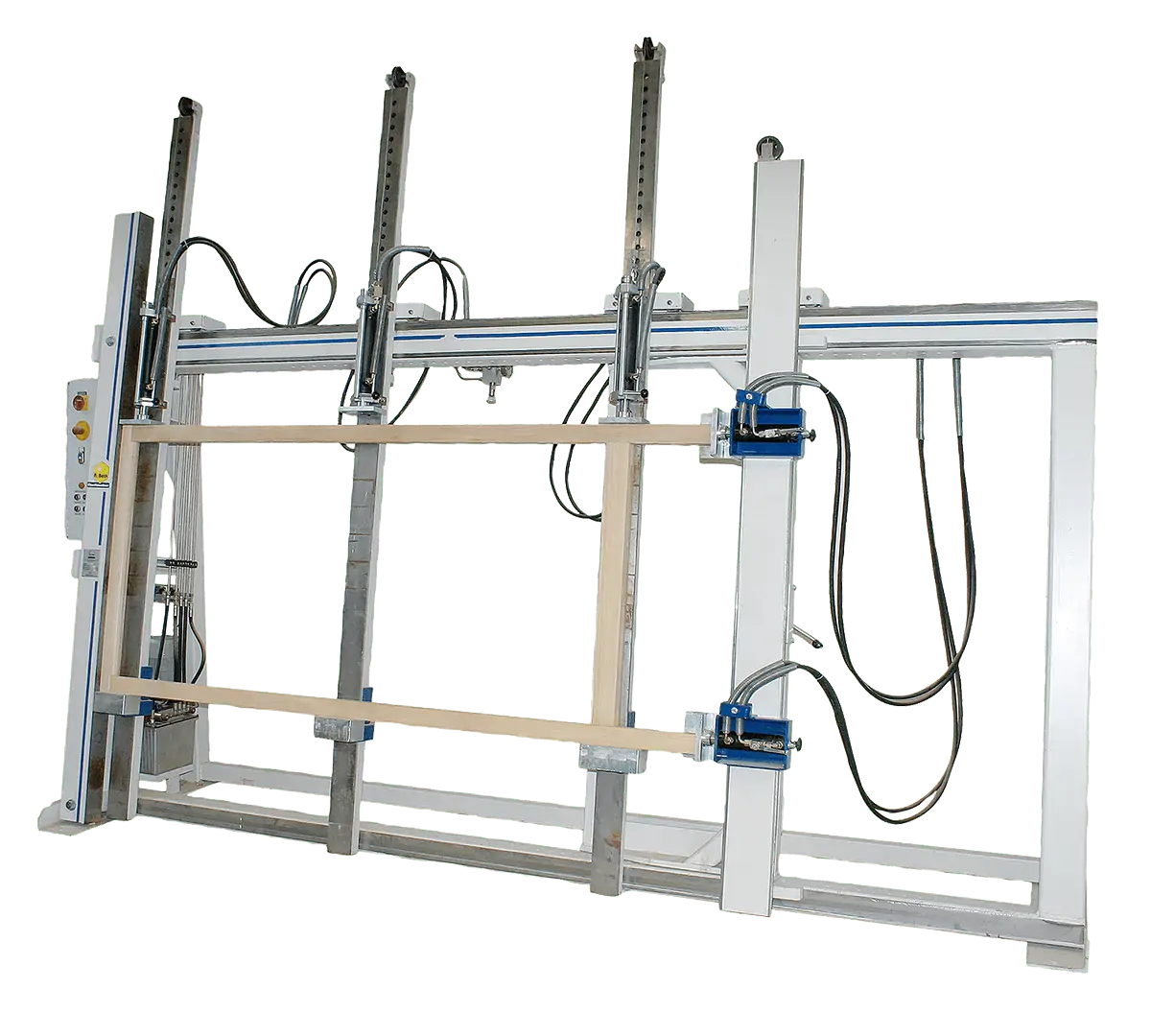
Frame presses are often hydraulically or pneumatically operated in order to build up sufficient pressure, because the press must be able to exert enormous forces, especially with larger wood cross-sections (e.g., window scantlings). There are models that generate pressing forces of up to 2,000 kg per clamping cylinder. Modern frame presses also usually allow quick conversion to different frame sizes thanks to sliding cylinders or clamping rails with quick-release clamps.
A particular advantage: even slanted or irregularly shaped frames (such as trapezoidal windows or stair railing frames) can be clamped using suitable options. For example, pendulum-mounted abutments can be used in special frame presses to securely glue even non-rectangular workpieces.
Perforated plate presses (perforated wall presses)
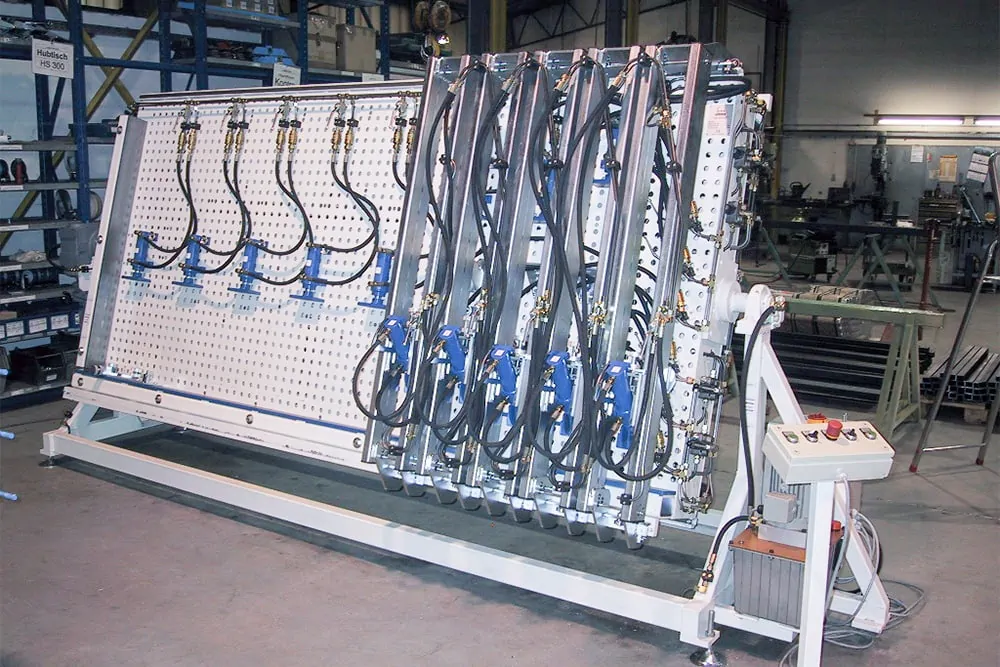
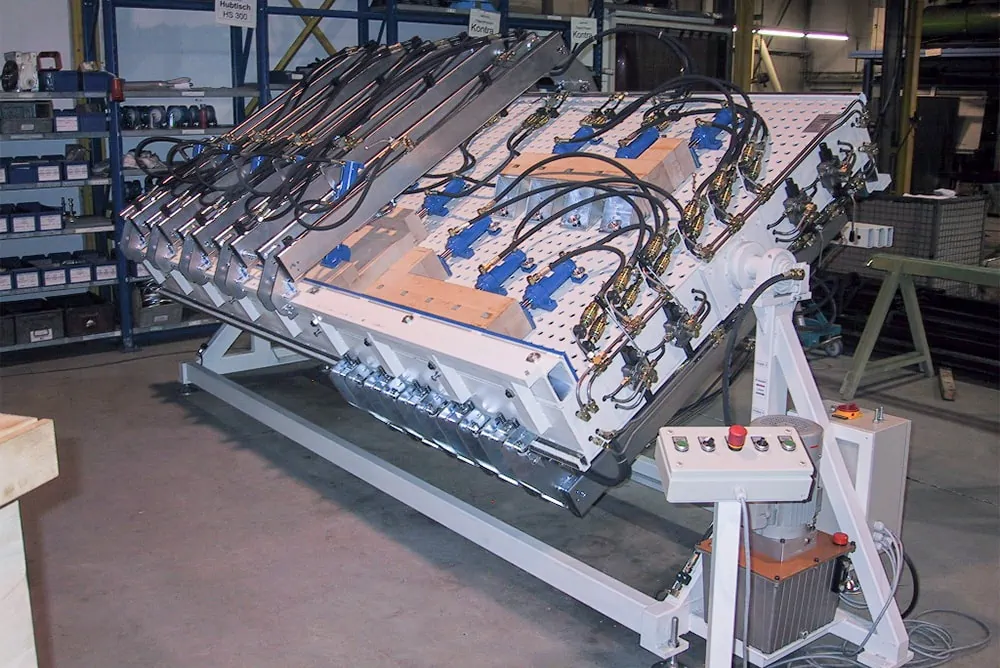
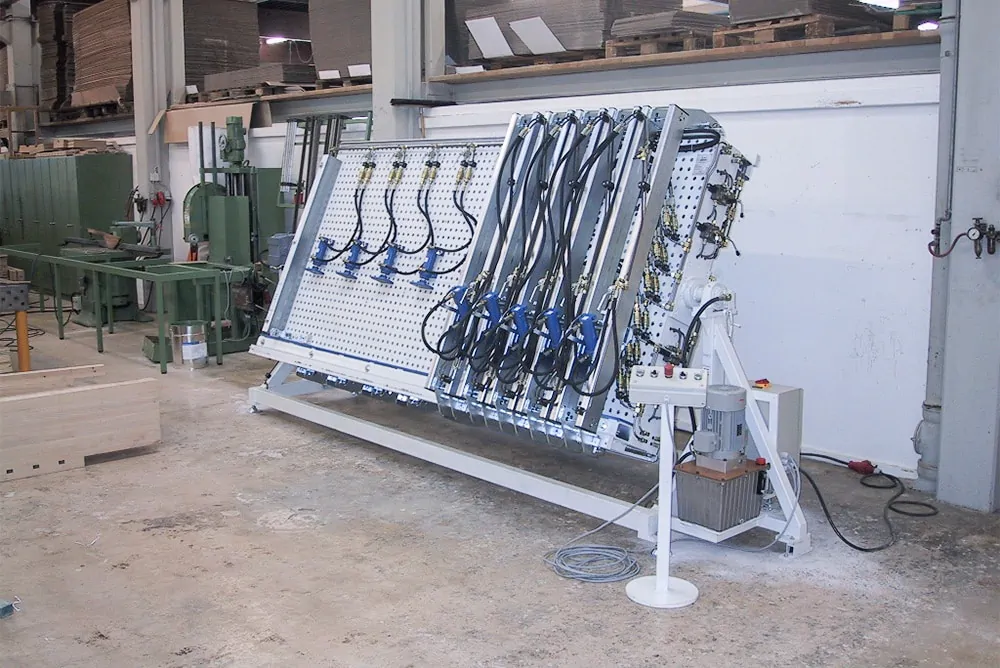
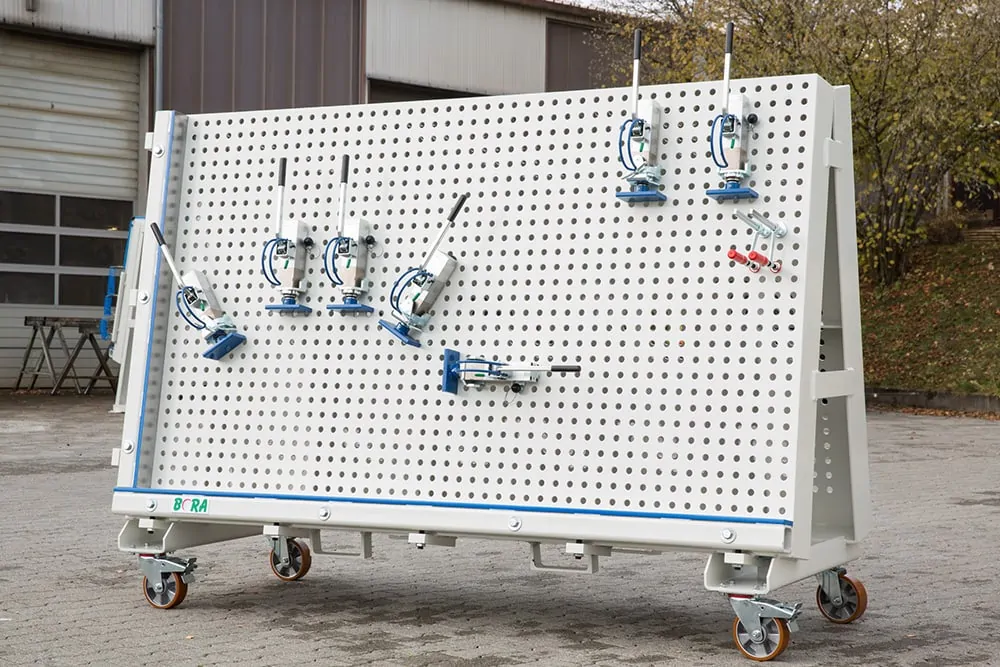
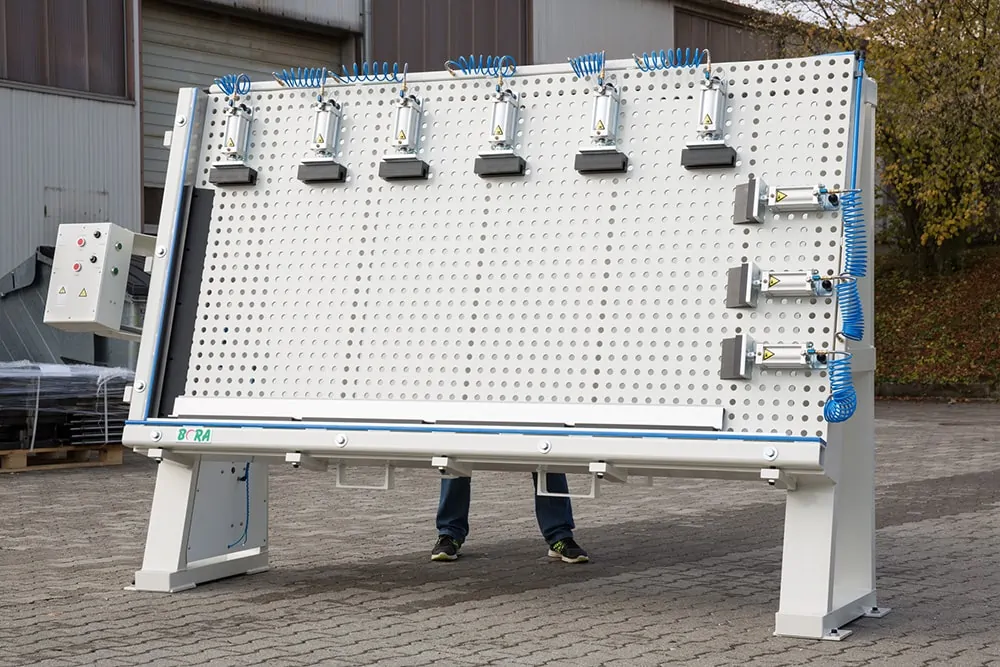
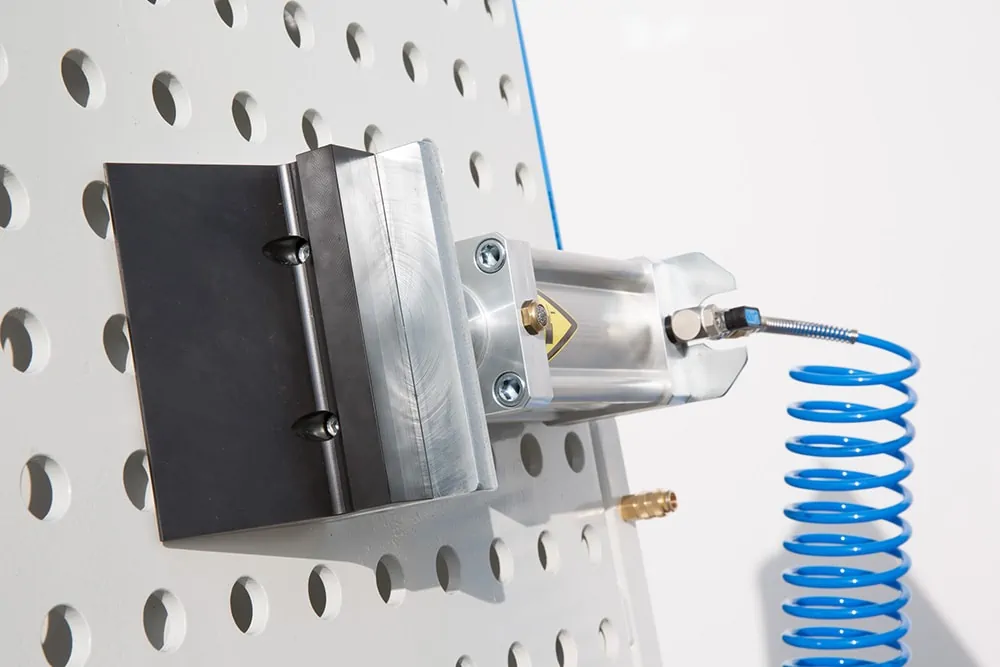
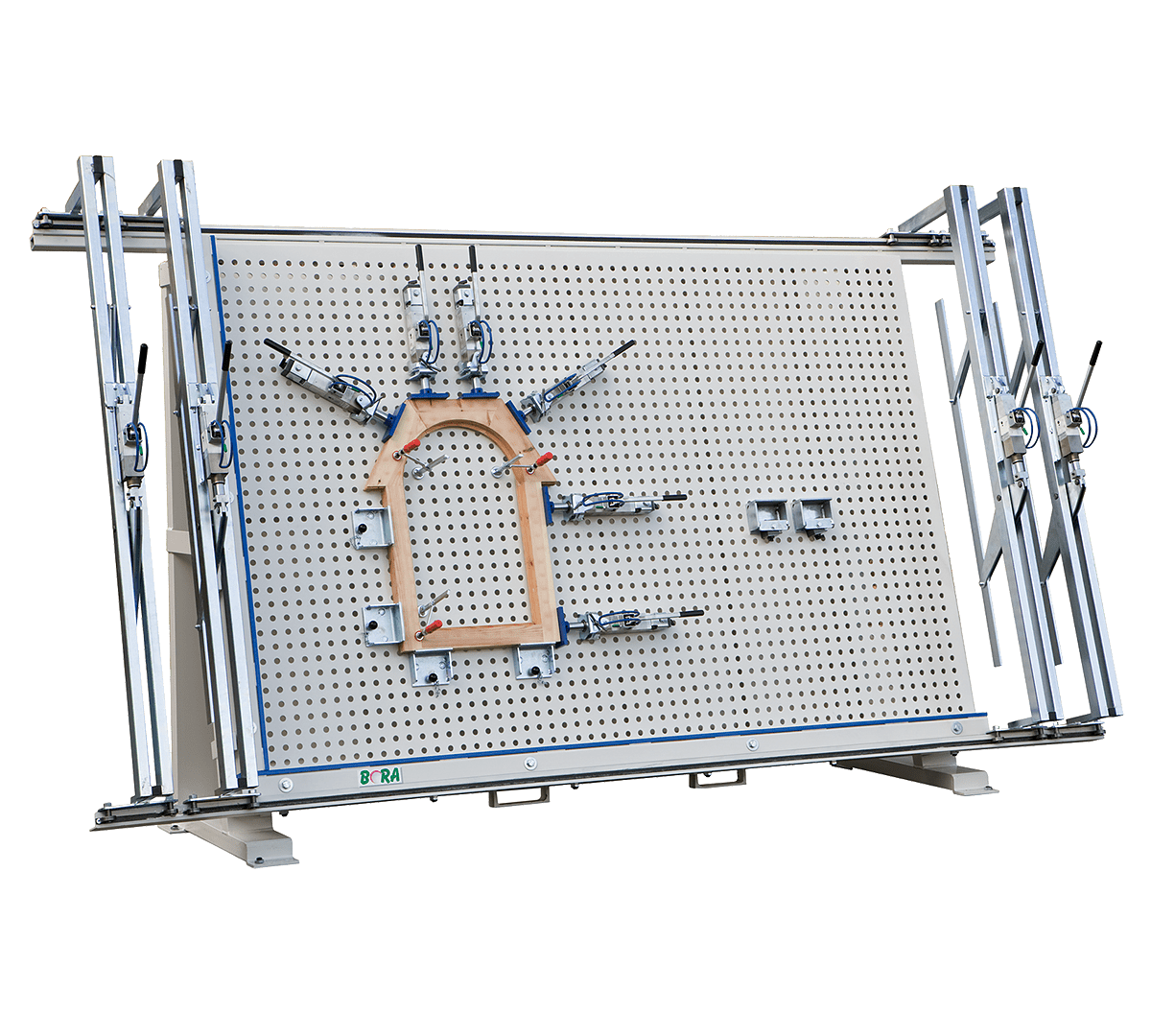
A perforated plate press (also known as a perforated wall press) has a vertical clamping wall made of thick sheet steel as its central element, which is provided with a regular hole pattern (typical hole spacing 50 mm). Angle brackets, pressure beams, clamping cylinders, and other elements can be quickly and variably inserted into these holes. This makes the machine extremely versatile: small and large workpieces, rectangular frames, or even curved shapes can be fixed to it.
Perforated plate presses – such as the BORA model – are often used as universal gluing presses in carpentry workshops. They can be used to manufacture doors, frames, panels, battens, stair treads, and laminated wood panels. The solid, torsion-free steel plate serves as a fixed support (abutment) against which the press elements press from the front. Optional accessories can be used to expand the functionality: there are swivel press cylinders for miters, differently shaped stops and corner brackets, hold-down devices for pressing from above, etc. Many of these press elements are hydraulically operated with a hand lever in the standard version, but can also be pneumatically or electro-hydraulically operated as required. This makes a perforated panel press suitable for both individual pieces (high flexibility during setup) and small series with changing formats.
Another practical aspect is ergonomics: in most cases, the entire clamping wall on these presses can be easily tilted or rotated to facilitate clamping and unclamping. Some models allow horizontal loading and can then be positioned vertically for pressing, combining back-friendly loading with space-saving curing in an upright position.
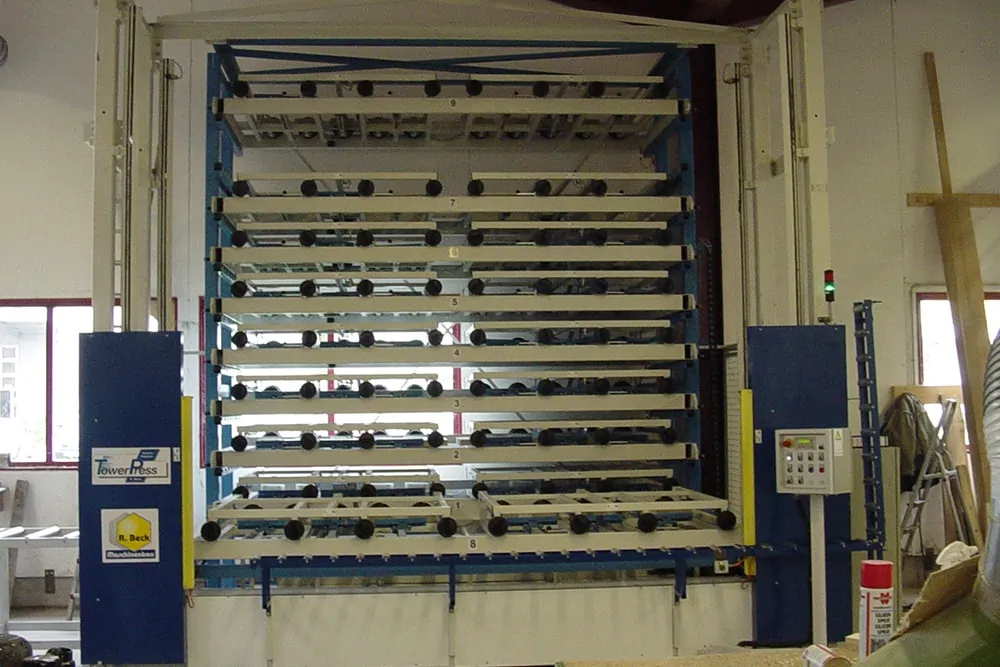
Multi-stage presses (multi-level presses)
A multi-level press is a gluing press that has several pressing levels one above the other – you could describe it as a “shelf” of pressing devices. Each level is a separate pressing surface on which a workpiece can be clamped and glued. All levels can usually be closed in parallel, allowing several parts to be glued at the same time. This design is primarily used when large quantities are involved or when pressing flat panel materials.
Typical multi-stage presses have 3 to 5 levels (sometimes even up to 10 or 15 in industrial veneer presses). In the wood industry, they are used, for example, to coat chipboard with veneer or to produce several glued wood panels in a single pass. The panels are arranged on each level between pressure beams or heating plates, which gives the machine its name. The parallel production of several parts significantly reduces cycle times.
Multi-level gluing presses are also used in furniture manufacturing, for example to glue frames or carcasses in series. One example is the KONTRA multi-level press, in which three or more levels can be folded down individually and are accessible. Each level has sufficient clamping cylinders and hold-down devices, which can be adjusted depending on the thickness of the workpiece. Pressure is often generated pneumatically-hydraulically to ensure uniform and gentle pressure distribution across all levels. Multi-level presses usually have strong steel frames in H-construction to absorb the load of several workpieces pressed simultaneously without distortion.
Glue stand
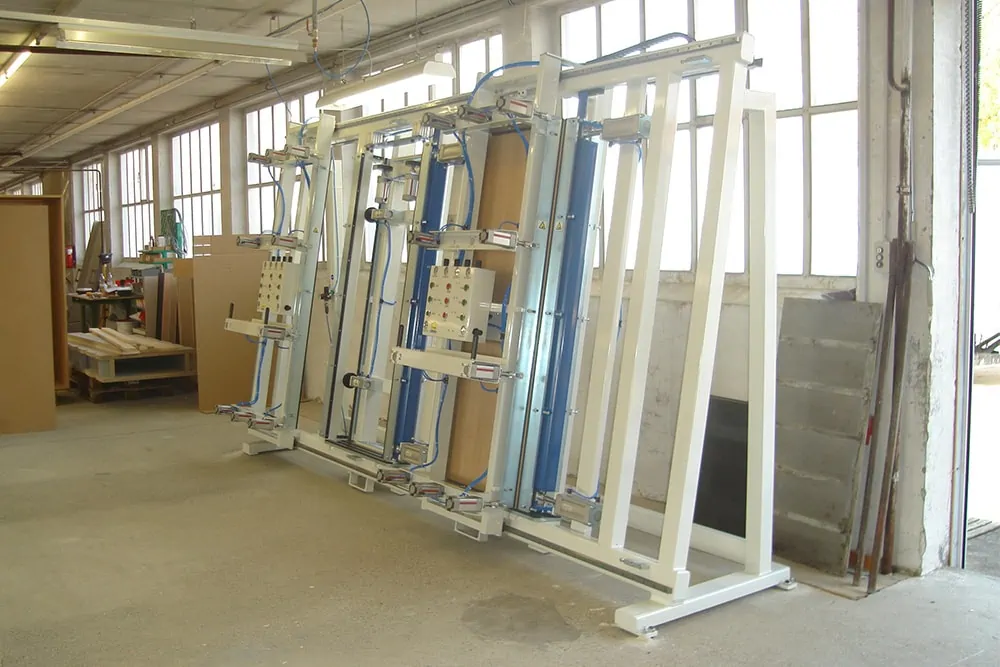
A gluing stand is a special type of gluing press that is often designed as a wall-mounted or free-standing clamping device. It can be imagined as an upright frame with several adjustable clamping strips or clamping frames. Gluing stands are often used in smaller workshops because they save space—they can be mounted on the wall or used as a mobile frame on casters.
A gluing stand typically consists of two side columns with cross beams, on which there are numerous clamping points. In the simplest mechanical version, these are rows of threaded spindles or eccentric clamps along the frame, which can be used, for example, to glue several boards together to form a panel. Professional gluing stands, on the other hand, are often equipped with manual hydraulic clamps. This allows many points to be clamped simultaneously with high pressure – some systems achieve up to 3,000 daN (approx. 3,000 kg) of pressure per clamping point.
A major advantage of the gluing stand is its universal applicability: it is suitable for gluing solid wood panels, for frame constructions (with optional frame press inserts), or for edge banding. Quick-release fasteners allow the size of the clamping surfaces to be adjusted quickly. Some models allow double-sided loading, i.e., you can load the front and back of the stand and thus glue even more workpieces in parallel. Gluing stands are often modularly expandable—for example, you can retrofit additional clamping frames, hold-down devices, or even entire frame press units. This allows gluing stands to form a bridge between individual machines and flexible modular systems for a wide range of gluing tasks.
Gluing presses: Areas of application in trade and industry
Gluing presses are primarily used in woodworking and the furniture industry—anywhere where wooden components need to be firmly joined together. Here are some typical areas of application:
- Furniture construction: Carpenters and furniture manufacturers use gluing presses to glue panels (for table tops, worktops, furniture fronts), to attach solid wood edges to veneered panels, and to glue frames and structures (such as chair frames or cabinet doors). Especially in the case of high-quality solid wood furniture, gluing presses ensure warp-free, even surfaces without misalignment.
- Window and door construction: Frame presses are a must in window construction for producing distortion-free window frames and door leaves. The precise 90° clamping angle ensures that the component remains at right angles, and the press holds the glued corners in place until the glue has hardened. Even multi-leaf doors or special shapes (arched windows, slanted windows) can be manufactured with appropriately adjustable presses.
- Stair construction: Wooden stair treads are often glued together from several wooden slats to achieve sufficient width. Solid wood gluing presses or gluing stands that can build up high pressures are used for this purpose. For example, a multi-level press (multi-level press) can be used to glue a set of steps in parallel. Special presses even allow spiral or sloping steps to be glued by tilting the stops accordingly.
- Series production of panels and carcasses: In industrial manufacturing—for example, by manufacturers of laminated wood panels, worktops, or carcass elements—large hydraulic multi-purpose presses or continuous press systems are often used. Multi-level presses coat chipboard with laminate or veneer on several levels simultaneously. Cabinet press attachments enable the rapid gluing of cabinet bodies in series, with all sides being clamped simultaneously. These systems are often partially or fully automated to increase throughput.
- Ambitious hobby workshops: Smaller gluing presses or gluing stands can also be found in the advanced DIY sector. For occasional use, there are, for example, mechanical frame presses with tension straps or corner clamps (for picture frames, etc.), or inexpensive gluing stands with threaded spindles. These allow DIY projects to be implemented in furniture quality—from glued cutting boards to homemade windows.
In short: wherever wooden parts need to be glued permanently and precisely, the gluing press shows its strengths. It speeds up work, increases the quality of results, and in some cases makes it possible to manufacture complex wood products in an economical way.
What should you look for when buying a gluing press?
If you want to buy a gluing press, you should choose the model that suits your requirements. The following criteria will help you make your decision:
- Size and clamping dimensions: Consider the maximum workpiece dimensions that occur in your application. The press must be large enough to accommodate these dimensions. Pay attention to the specified usable dimensions (width × height) of the machine. For example, Beck Maschinenbau offers gluing presses in various sizes up to 4×2 m clamping area. For very long workpieces or many parts at the same time, double-sided or expandable presses may be useful. Some manufacturers also supply presses in special lengths up to 10 m.
- Pressure and system: Depending on the workpiece and glue joint, you will need a certain amount of pressure. For light frames made of soft wood, a manual clamping system (rack and pinion or spindle) may be sufficient. For solid wood or large-area gluing, hydraulic or pneumatic systems are better, as they can easily generate higher forces (often 1–2 tons or more). So check whether the press has manual hydraulics, foot hydraulics, pneumatic cylinders, or electric pumps, and what the specified pressure capacity is. As a guide, a rack and pinion gear delivers approx. 1,000 kg of pressing force, while a 2-stage hydraulic system can achieve up to ~2,000 kg.
- Design according to application: Select the type according to your main tasks. A frame press is ideal for mainly frame and miter joints. If, on the other hand, you need versatility, a perforated plate press is a good choice, as it can clamp a wide variety of shapes. If you want to produce many panels or manufacture in series, consider a multi-stage press. In small workshops with changing tasks, a modular gluing stand could be the most flexible solution. Manufacturers often offer combined systems, e.g., gluing stands with optional frame press equipment.
- Equipment and accessories: Check which stops, hold-down devices, and press elements are included as standard and what is available as an option. Important items include sufficient corner stops for right-angled frames, spacers for different workpiece thicknesses, heating rails (if glue needs to be heated), and special pads for sensitive surfaces. A comprehensive range of accessories—such as those offered by Beck with its LogDos glue application technology and various clamping units—leaves nothing to be desired. Also consider whether the press should be mobile or permanently installed. Mobile presses with casters increase flexibility in the workshop.
- Operation and ergonomics: User-friendliness is a major advantage. Can the clamping points be adjusted quickly (keyword: quick-clamping system)? Are there foot pedals so that both hands are free to position the workpiece? Is there a pressure gauge to control the pressure build-up? Features like these make work safer and easier. Hydraulic presses should also be equipped with an emergency stop device or a safety valve to prevent overload.
- Workmanship and quality: Finally, it is worth taking a look at robustness: a fully welded, torsion-resistant frame is important for durability and accuracy. High-quality presses are usually powder-coated (corrosion protection) and rely on low-maintenance hydraulic components. Since gluing presses are a long-term investment, quality pays off here – the machine will serve you reliably for years and deliver precise results.
If you take all these aspects into account, you will find the right gluing press for your needs. Many manufacturers, such as Reinhold Beck Maschinenbau, offer non-binding advice to help you select the optimal model from their product range. This ensures that your new press is exactly right for your workshop and your workpieces.
Glue applicators – the perfect addition
Efficient gluing involves not only pressing, but also applying the glue. This is where glue application devices come into play. Systems such as the LOGDOS series from Beck enable quick, clean, and even distribution of glue on wooden surfaces.
Glue applicators essentially consist of a glue container and an application gun or nozzle. LOGDOS devices are characterized by high efficiency and universal application possibilities. There are different container sizes and various accessories available—from special glue hoses to application rollers—so that the right product is available for every application. A special feature: the containers not only store the desired amount of glue, but also compressed air, which is used to apply the glue under pressure. This makes these devices self-sufficient and eliminates the need for a permanent connection to a compressor or compressed air line. This means that the glue gun can be used over a large area without being tied to hoses.
For you, this means fewer glue drops, even glue joints, and time savings during application. In combination with a gluing press, such a glue dispensing device forms the basis for a smooth gluing process—from application and pressing to the finished component.
Frequently asked questions about gluing presses
What is a frame press?
A frame press is a special type of gluing press designed specifically for gluing rectangular frame structures. In the woodworking industry, this refers to a press that can glue window frames or door frames, for example, in a single operation. It usually has a fixed 90° angle stop and pressure cylinders that press against the frame from two sides (horizontally and vertically) so that all four corners are glued simultaneously and held at right angles. Frame presses are therefore ideal for ensuring precise angularity in frames and stiles. (Note: In the metal industry, the term is sometimes also used for presses with specific frame designs – see H- and C-frame presses – but in woodworking, frame press primarily refers to the gluing press for wooden frames.)
What is an AC frame press?
The term AC frame press usually refers to workshop presses manufactured by AC Hydraulic. AC Hydraulic A/S is a Danish manufacturer that primarily offers hydraulic workshop presses (often H-frame design) for use in automotive workshops and industry. An AC frame press is therefore not a woodworking machine, but a heavy-duty press for pressing in and out bearings, bending metal, or similar tasks. These presses have a robust, fully welded frame (hence the name frame press) and operate hydraulically with sometimes very high pressing forces (e.g., 40 tons for the P40H model). Typical features include a wide H-shaped base frame for high stability, a laterally movable press cylinder for flexible positioning, and safety features such as overload valves and pressure gauges. In short, an AC frame press is an industrial hydraulic press for metalworking – in contrast to a woodworking gluing press, which joins wood with comparatively lower forces.
What is the difference between a C-frame and an H-frame press?
The terms C-frame and H-frame refer to the design of the press frame, especially in metal and hydraulic presses. A C-frame press (also known as a C-frame press) has a frame that is open on one side and resembles the letter “C” in shape. The workpiece can be inserted into the open frame from the front, which makes loading easy. C-frame presses are usually more compact and allow work to be carried out on smaller parts or in confined spaces – however, due to their design, they are slightly less torsion-resistant. An H-frame press, on the other hand, has two side stands and a crossbeam at the top, which visually resembles an “H.” This closed four-column frame gives the press a very high degree of stability. H-frame presses can therefore exert greater forces without the frame warping. In comparison, the H-design is ideal for heavy, large workpieces, while the C-design offers greater accessibility but can yield slightly under maximum load. In summary, C-frame presses are more flexible in terms of workpiece handling, while H-frame presses are more stable and designed for higher pressing pressures.
What is an H-frame press used for?
H-frame presses are used wherever very high pressing forces and absolute stability are required. They are typically used in metalworking and heavy industrial applications. Examples: In automotive workshops for pressing out axle bearings or straightening frames; in the aerospace industry and mechanical engineering for bending, punching, or straightening large metal parts; in forging shops or foundries for pressing and calibrating workpieces. Thanks to their stable H-frame construction, these presses can exert forces weighing several tons.

Your contact person:
Marcus Futterknecht
Distribution & Spare Parts
OUR NEW
2026 CATALOG
NEWSLETTER
SUBSCRIBE
BECK PRODUCTS
IN THE ONLINE SHOP
-

Lifting
-
Lowering
-

Conveying
-

Rotating
-

Tilting
-

Swivelling
Lifting
Lowering
Conveying
Rotating
Tilting
Swivelling